Built-in vs Portable Outdoor Pizza Oven: Installation, Cost and Throughput (2026 Data)
- Share
- publisher
- Kangye Electric Team
- Issue Time
- Nov 12,2026
Summary
A 2026 comparison of built-in and portable outdoor pizza ovens: what a masonry cavity changes, the ventilation, clearance, gas line and permit load a built-in carries, installed cost bands for each route, realistic pizzas per hour against stone recovery, and what the product-form split means for importers stocking the category.
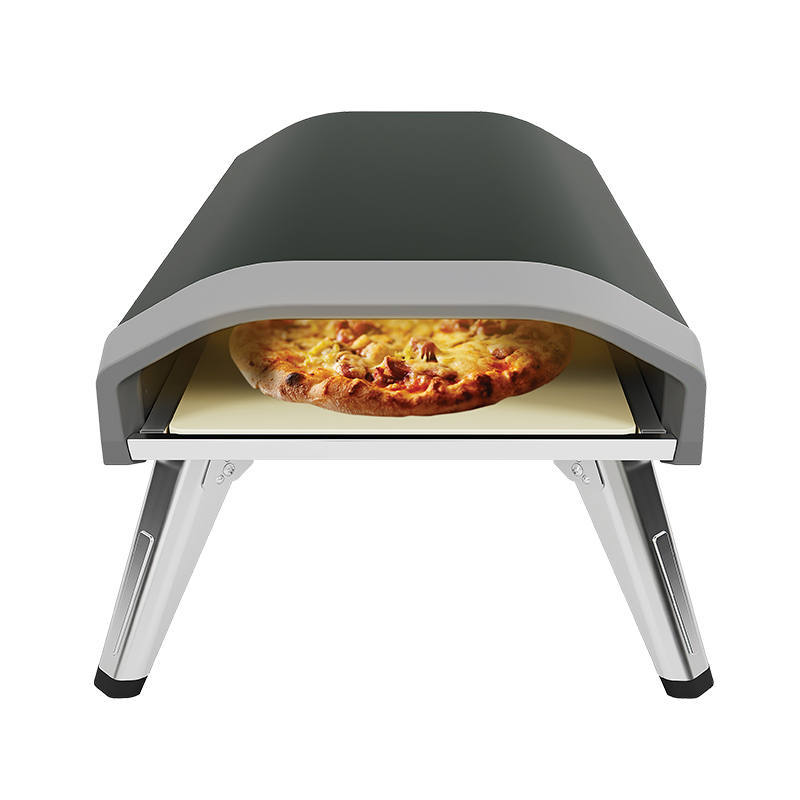
Short answer: pick a built-in pizza oven when the unit belongs to a permanent outdoor kitchen with a fixed gas line and a service that runs most weekends; pick a portable oven when capital, mobility or a seasonal site decides the job. In 2026 a built-in installation lands at $2,500–$8,000+ against $400–$1,500 for a portable oven (BetterPatio, 2026).
Both configurations reach buyers through the same channels, often from the same brand, yet they answer different questions: how an oven survives a decade inside a masonry cavity, and how quickly it moves and stores. Installation, cost and throughput all follow from that split.
What Actually Changes When a Pizza Oven Goes Built-In?
The flame does not change when a pizza oven goes built-in; the thermal mass around it and the rules that govern its enclosure do.
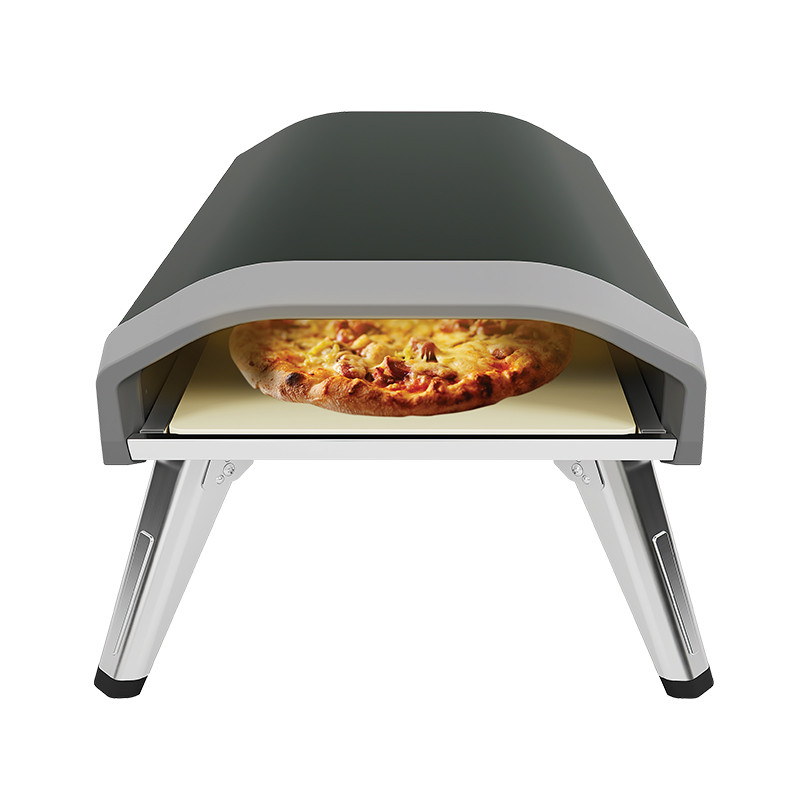
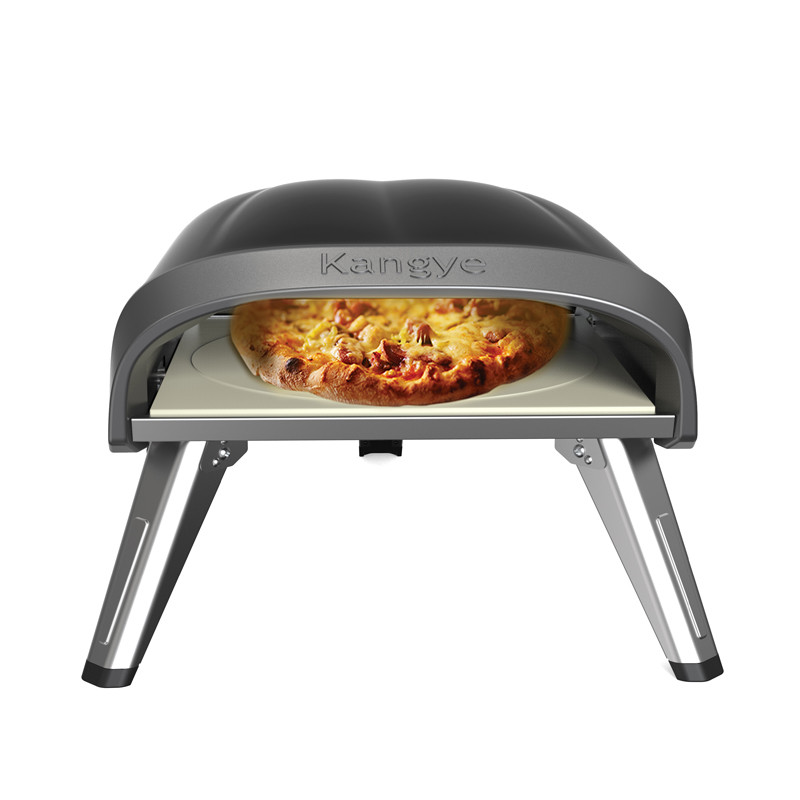
A portable gas oven is a burner, a cordierite stone and a shell. Kangye Electric builds its 4 kW KYQ-KPS12A and KYQ-KPS12B to an overall 668 × 425 × 290 mm with a 335 × 335 mm stone, reaching 400 °C in about 15 minutes and baking a 12-inch pie in under 90 seconds. A built-in oven carries a refractory dome or a heavy stone deck inside a structure the buyer builds once — and that mass is why heat-up stretches to 30–90 minutes on masonry units (Dough Dorks, 2026). What the buyer gains is heat that does not fall away between bakes.
| Dimension | Portable gas oven | Built-in oven |
|---|---|---|
| Cooking surface | 12–16 in typical | 20–40 in typical |
| Unit weight | 40–65 lb | 400–1,000+ lb |
| Heat-up to baking temperature | 15–25 min on gas | 30–90 min on masonry |
| Installation scope | Heat-safe table or counter | Island cavity, vents, gas line, permit |
| Mobility | Moves and stores | Fixed to the structure |
| Unit price, 2026 | $400–$1,500 | $2,000–$8,000+ |
Sources: Luxury Appliance Guides (2026) for surface and weight; Dough Dorks (2026) for heat-up; BetterPatio (2026) for pricing.
Installation: The Part Buyers Consistently Underestimate
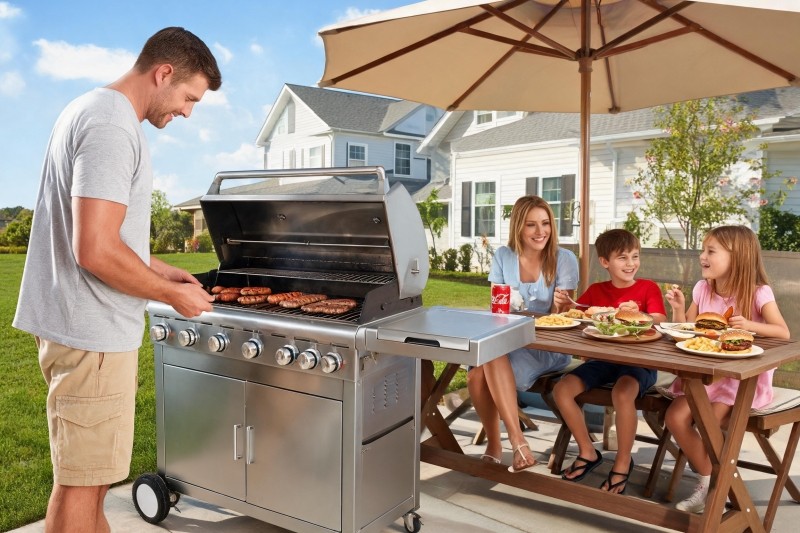
A portable pizza oven needs a heat-safe surface; a built-in oven needs a cavity, ventilation, clearances, a gas line and, in most jurisdictions, a permit.
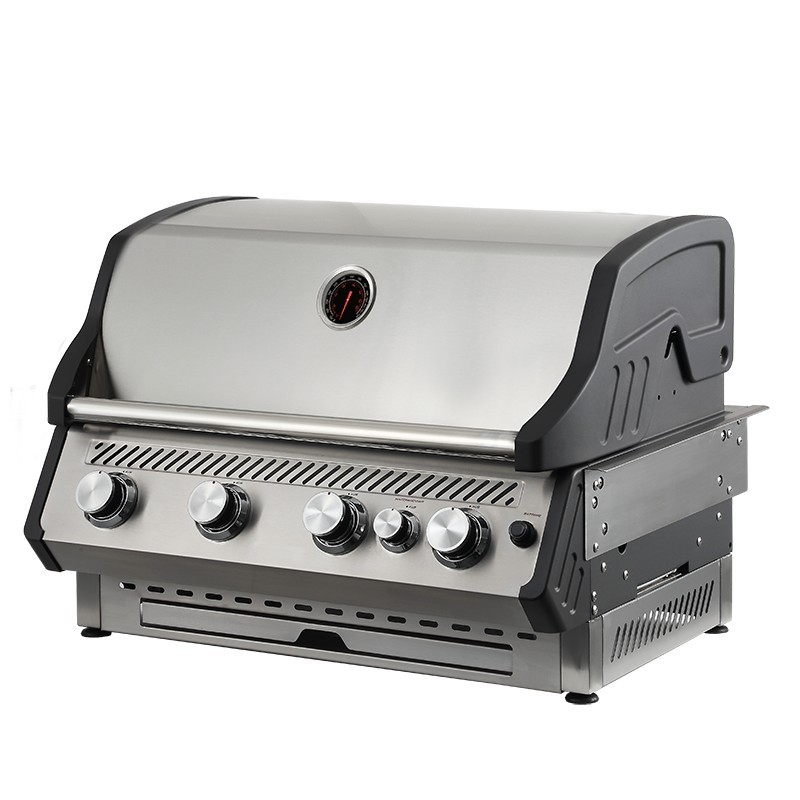
Start with the cutout. A built-in body must be drafted from the manufacturer's cutout sheet rather than from its overall dimensions — Kangye Electric's built-in gas bodies measure 859 × 668 × 594 mm (KYQ-194RM) and 710 × 668 × 594 mm (KYQ-193RM), and the island opening, flange overlap and service access all come off that drawing.
Ventilation is where installations fail inspection. RTA Outdoor Living's 2026 review of major brands found most manufacturers require at least 20 square inches of vent area at both the top and bottom of each side of an island, with openings on three sides for cross-flow. Some 2026 island specifications go further: 100 square inches per compartment split across at least two sides, formalised in the 2025 California Building Standards Code that took effect on 1 January 2026 (Pacific Beach Builder, 2026). Placement is fuel-specific — propane is heavier than air and must vent low, natural gas rises and must vent high (Anvil Field, 2026, citing NFPA 54 and NFPA 58).
Clearances follow the same logic. Sides need 12–24 inches to combustible material, and a covered installation needs 36–48 inches between the cooking surface and any combustible overhead (KBB, 2026; 360 Home Inspections, 2026). Building Commission NSW went further in Note 1/2026: an appliance certified for outdoor use must never end up enclosed by later building work, because trapped flue gases create a carbon-monoxide risk under AS/NZS 5601.1:2022.
| Requirement | Built-in oven | Portable oven |
|---|---|---|
| Cavity and cutout | Drafted from cutout sheet, non-combustible framing | None |
| Ventilation | 20 sq in top and bottom per side, cross-flow; low for LP, high for NG | Open air by default |
| Clearance | 12–24 in to combustibles at the sides, 36–48 in overhead | 12–36 in to combustibles |
| Gas supply | Fixed line, shutoff valve, leak test, sized to connected load | 20 lb cylinder and hose |
| Permit | Gas, electrical and often building permit, $300–$1,200, 2–4 weeks | None |
Sources: KBB (2026), Pacific Beach Builder (2026), Anvil Field (2026), Pizza Oven HQ (2026).
Cost: Upfront, Installed, and Per Bake
The installed gap is four to six times the portable price, and almost all of it sits in the surround rather than in the oven.
Unit prices already separate widely, but the enclosure is the line that decides the project. A drop-in oven with a basic masonry surround runs $2,500–$5,000 and a full custom stone build $5,000–$8,000+, before a gas line that can add $200–$1,200 (BetterPatio, 2026).
| Cost line | Portable oven | Built-in oven |
|---|---|---|
| Oven unit | $400–$1,500 | $2,000–$8,000+ |
| Alternative unit reading | $150–$800 countertop | $1,500–$6,000 modular, $2,000–$12,000 stone |
| Surround or enclosure | None | $500–$3,000 within a $2,500–$5,000 drop-in build |
| Labour hours | 2–6 h | 8–20 h |
| Gas line | Cylinder, no line | $200–$1,200 |
| Permits | None | $0–$1,000 |
| Fuel cost per running hour | About $1–$1.25 on gas | Same rate, larger burner |
Sources: BetterPatio (2026), WellBuilt Florida (2026), LatestCost (2026).
Fuel draw is modest either way. Gas pizza ovens burn roughly 1–1.5 lb of propane per hour at full output, and a 20 lb cylinder holds about 430,000 BTU, which works out to 7–15 hours of runtime depending on burner size (Pizza Oven HQ, 2026). Running the arithmetic on the figures above — 15 pies an hour at the $1–$1.25 hourly gas rate — puts energy at roughly $0.07–$0.08 per pizza. That is a derived estimate from two published inputs, not a measured value.
Throughput: Pizzas per Hour, Measured Against Recovery
Throughput is governed by how fast the stone recovers and how many hands are free, not by whether the oven is built in.
Recovery is the number that decides a service. A well-tuned gas oven claws its floor temperature back in 2–3 minutes between pies, which supports 8–10 pizzas an hour; a wood oven whose fire banks down needs 5–8 minutes and roughly halves output (Dough Dorks, 2026). Once staging is tight, a 90-second bake with 30–60 seconds of stone recovery settles at 15–20 pizzas an hour in practice (PizzaTechHQ, 2026), and with two operators running 60–90 second bakes it reaches 30–40 an hour (NSKN, 2026). Commercial deck ovens sit at 60–80 an hour, gas domes at 50–70, wood-fired units at 40–60 and electric decks at 15–20 (EatHealthy365, 2026).
| Setup | Bake time | Recovery | Realistic output | Best fit |
|---|---|---|---|---|
| 12 in portable gas, one operator | 60–90 s | 30–60 s | 15–20 per hour | Patio and family service |
| 12 in portable gas, two operators | 60–90 s | 1–2 min | 30–40 per hour | Events and pop-ups |
| Built-in gas dome | 60–90 s | 2–3 min floor | 8–20 per hour | Permanent outdoor kitchen |
| Commercial gas deck | 3–5 min | Very fast | 60–80 per hour | Volume foodservice |
| Commercial electric deck | 5–7 min | 10–15 min | 15–20 per hour | Sites where gas is barred |
Sources: Dough Dorks (2026), PizzaTechHQ (2026), NSKN (2026), EatHealthy365 (2026).
The built-in advantage is not speed, it is stability. A masonry cavity holds floor temperature through a long service, while light portable shells lose heat faster in wind and cold — a limitation Dough Dorks flags directly for compact ovens with less stored energy (2026). Below about 40 pizzas in an evening, that difference rarely shows up in the pizza.
Which Configuration Should an Importer Stock in 2026?
Portable gas ovens own the unit volume; built-in owns the project sale, and the two rarely compete for the same purchase order.
Product-form data makes the split explicit: portable ovens represent about 61.5% of outdoor pizza oven demand, and gas is the largest fuel segment at 42.8% (pmarketresearch, 2026). The category itself is expanding — $502.15 million in 2025, $563.28 million in 2026 and $1.07 billion by 2032 at an 11.45% CAGR on that tracker, against a second reading of $569.02 million in 2025, $597.36 million in 2026 and $925.11 million by 2035 at 4.98% (Global Growth Insights, 2026). Different scope, same direction.
For the US picture, BBQ Authority puts the market near $800 million in 2026 growing at 6.1% CAGR, with North America at 42.05% of global value and countertop ovens still outselling built-ins at 8.92% CAGR while built-in installations rise alongside outdoor kitchen construction (2026). That is a portfolio signal rather than a single-SKU signal: a brand that stocks only portables leaves the premium project buyer to a competitor, and a brand that stocks only built-ins pays for a masonry lead time on every order.
Kangye Electric covers both ends from one factory — the 4 kW KYQ-KPS12A and KPS12B portables, and built-in gas bodies at 859 × 668 × 594 mm and 710 × 668 × 594 mm. The freight arithmetic differs enough to affect landed cost: a portable 4 kW oven loads 328 pieces per 20GP, 688 per 40GP and 857 per 40HQ, while built-in bodies load 200–216 per 40HQ (Kangye Electric trading data, 2026). Lower cube per unit favours the portable line on freight; a higher ticket favours the built-in line on margin, provided the brand can supply an installation story with it. The company has manufactured since 1989 on a 150,000 m² site with 200+ engineers and monthly capacity above 200,000 units, holds ISO 9001 and CE/GS/CB/ETL/AGA/CSA/LFGB/FDA coverage, and exhibits at IFA Berlin.
Adding a Pizza Oven to the Range?
Kangye Electric builds the KYQ-KPS12A and KPS12B 4 kW gas pizza ovens alongside built-in gas grill bodies, with published container quantities, OEM branding and CE/GS/CB/ETL/AGA/CSA/LFGB/FDA coverage from a single ISO 9001 plant.
See the KYQ-KPS12AFrequently asked questions
Can a portable pizza oven be built into a counter?
No. Tabletop and cart units are not listed for enclosed installation, and a built-in rating exists because the cavity restricts airflow — modifying a portable unit to fit one is a safety error, not a workaround (KBB, 2026).
How much ventilation does a built-in pizza oven island need?
Most manufacturers specify at least 20 square inches at both the top and bottom of each side with cross-flow, while some 2026 island specs call for 100 square inches per compartment across two sides (KBB, 2026; Pacific Beach Builder, 2026). Vent low for propane, high for natural gas.
Is a built-in oven faster to heat than a portable?
Usually slower. Portable gas ovens reach temperature in 15–25 minutes, while masonry and refractory built-ins need 30–90 minutes to heat-soak (Dough Dorks, 2026). The built-in wins on heat retention during a long service, not on start-up.
Do I need a permit for a built-in pizza oven?
In most US jurisdictions a fixed gas appliance in a masonry island needs a gas permit and often a building permit: budget $300–$1,200 and two to four weeks of processing before the island is closed up (Pacific Beach Builder, 2026).
Sources and Data Notes
BetterPatio (2026): unit price bands, surround cost, gas line cost, hourly running cost. Luxury Appliance Guides (2026): surface and weight by configuration. WellBuilt Florida (2026): cost ladder, labour hours, annual fuel. LatestCost (2026): modular versus masonry pricing, permits. Dough Dorks (2026): heat-up ranges, recovery times, hourly output, wind sensitivity. PizzaTechHQ (2026): realistic throughput on a single 12-inch oven. NSKN (2026): two-operator output and bake-time bands. EatHealthy365 (2026): commercial deck, dome, wood and electric throughput. KBB (2026, citing RTA Outdoor Living): vent area rule, side clearances, non-listed appliance warning. Pacific Beach Builder (2026): vent area per compartment, permit cost and timing, 2025 California Building Standards Code. Anvil Field (2026): NFPA 54 and NFPA 58 vent placement by fuel. 360 Home Inspections (2026): overhead clearance. Building Commission NSW Note 1/2026: AS/NZS 5601.1:2022 enclosure and carbon-monoxide risk. pmarketresearch (2026) and Global Growth Insights (2026): market size series, shown side by side because scope differs. BBQ Authority (2026): US market value, growth rate, regional share, countertop versus built-in CAGR. Kangye Electric product and trading data (2026): model dimensions, power, stone size, container quantities. The per-pizza energy figure is a derived estimate from published inputs, not a measured value.